Hilda van Gleck—Gretel Brinker
Hans Brinker, or The Silver SkatesHilda van Gleck’s relationship with Gretel Brinker is established through a small but consequential act of attention. At a skating gathering, Hilda notices that Gretel is cold and poorly equipped; she responds first with concern, then with a warm jacket and skates. The exchange places two girls of nearly the same age on unequal social footing, yet lets care cross that divide in concrete form. Gretel’s ability to skate is not created by Hilda’s generosity, but the gifts allow that ability to be seen and enjoyed under less punishing conditions.
A meeting on the ice
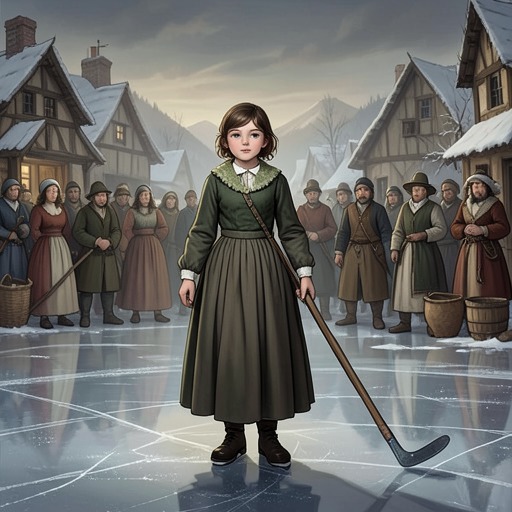
Hilda encounters Gretel while watching the skating. After joining a group of racers and sailing past them, she stops beside the eager-eyed child and asks her name. Gretel answers that she is Gretel and identifies her brother, Hans Brinker. Hilda’s attention begins in this ordinary introduction, but quickly shifts to Gretel’s condition: she thinks Hans looks sturdy and warm, while Gretel appears cold, and tells her she should wear more clothing.
Their ages make the difference between them noticeable rather than absolute. Gretel says she is past twelve; Hilda explains that she is nearly fourteen and so large for her age that other girls seem small beside her. The conversation is friendly, but it also reveals how easily Hilda’s physical confidence and comfortable circumstances can shape her view of someone else. She suggests Gretel needs warmer clothes without yet understanding that Gretel has no spare clothing to put on.
Concern, embarrassment, and dignity
Hilda’s observation lands painfully. Hans sees tears rising in Gretel’s eyes and answers on her behalf that she has not complained of the cold, though the weather is bitter. Gretel then minimizes her discomfort, saying she is often warm, especially when skating, and thanks Hilda for thinking of her. Her reply preserves her courtesy and self-command, but the scene has already made visible what the family’s poverty conceals: warmth is not simply a matter of choosing another garment.
Hilda recognizes that her concern has been clumsy. She calls herself careless and cruel, insists she meant no harm, and tries to move toward the reason she approached the children in the first place. Her faltering matters to the relationship: kindness does not make her instantly adept at crossing the social distance between them. Rather than treating Gretel as a passive object of pity, the scene gives her a response of her own—an effort to reassure Hilda and remain composed even while Hans’s words expose the hardship she had not volunteered.
From notice to material help
The practical obstacles become clearer when Gretel and Hans explain why they cannot join the skating as the better-equipped children do. Their skates are hard wood; once damp, they stick and trip them. Gretel can laugh at Hans’s earlier mishap, but she asks only whether they may come on the great day to watch. The modest request makes the gap between their eagerness and their means especially plain: they want to share the occasion, yet their equipment will not let them skate comfortably with the others.
Hilda wants to help, but her own resources are limited. She regrets having spent much of her monthly allowance on lace and finery; only eight kwartjes remain, not enough, at most, for more than one pair of skates. The detail prevents her generosity from appearing effortless. She is privileged in comparison with the Brinkers, but she is also a young person working out what she can give. Later, the story makes clear that Gretel receives the shining skates as Hilda’s gift, while Dame Brinker repairs Gretel’s burst-out shoes and Hilda gives her a warm jacket.
What the gifts change
The following day, Gretel skates among the crowd in the canal, weaving in and out with dexterity. Her jacket is warm, her shoes have been patched into decency, and the shining runners carry her across the ice. She is absorbed in the pleasure of skating and unaware of the many wondering looks directed at her. The narrative links her new freedom of movement to more than Hilda’s intervention: Hilda supplies the jacket and skates, while Gretel’s skill and enjoyment are already her own, and Dame Brinker contributes the repaired shoes.
The response of the other skaters shows the public consequence of that assistance. Peter van Holp notices the small girl in the red jacket and patched petticoat, marvels at how well she skates, and jokes that she might beat Katrinka Flack in the race. Carl Schummel points out that she is Hilda’s special favorite and that the shining skates were Hilda’s gift. Gretel’s changed appearance draws attention, but it is her skating that sustains it: the aid makes participation possible, and her ability turns that opportunity into a visible achievement.
Significance and scope of the relationship
The episode presents Hilda and Gretel’s connection as an instance of charity made specific. Hilda does not merely feel sorry for a poorly dressed child; she notices the cold, hears the material limits imposed by wooden skates, and gives what she can. The episode also preserves the awkwardness within that generosity. Gretel must absorb an unintended wound before Hilda understands the delicacy of the situation, and Hilda’s self-reproach follows her recognition of that mistake.
The relationship’s meaning in the supplied scenes rests on this encounter and its immediate aftermath, not on evidence of a long-established intimacy. Its importance lies in the change from watching Gretel as a cold, under-equipped child to seeing her move confidently among the skaters. In a book that describes itself as joining travel instruction to a domestic tale, this small exchange gives social observation a household-scale consequence: differences in clothing, allowance, and equipment become visible on the ice, and generosity alters what Gretel can do there without diminishing what she can do for herself.